Red Sea shipping
What did the Houthi attacks on ships, from November 2023, do to world shipping? Measured from satellite-tracked ship counts.
- Type
- Data analysis
- Year
- 2026
- Built
- 26 October 2026
- My part
- The questions, the choice of baseline, checking results against events, and the write-up
- Built with
- Claude Code (AI coding assistant)
- Tools
- SQL (DuckDB), Python for downloads only
- Data
- IMF PortWatch: daily ship counts at 28 chokepoints and about 2,000 ports, 2019 to October 2026
The question
The Red Sea and the Suez Canal are the short route between Asia and Europe. When ships there came under attack from November 2023, I wanted to measure how many stopped using it, where they went instead, which kinds of ship kept going, and whether traffic has come back.
How I built it
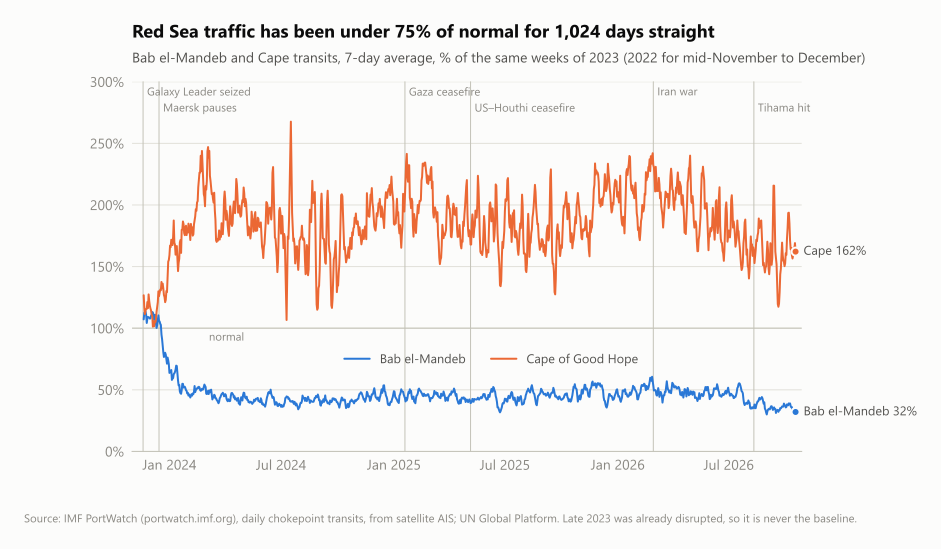
The data counts ships from the position signals they broadcast, picked up by satellites. The main design choice was what counts as “normal”. Shipping has weekly and seasonal rhythms, so I compare each day with the same week and weekday of 2023, before the attacks, and smooth both with a 7-day average. 100% means normal for the time of year.
PortWatch publishes each table twice: as a bulk file, three months out of date for ports when I downloaded it, and through a live API. I combine the two, keep the newer rows, and record where each row came from.
What I found
- Red Sea traffic halved within two months and hasn’t come back. It has run at 35 to 52% of normal every month since February 2024. Neither ceasefire in 2025 moved it by more than 2 points.
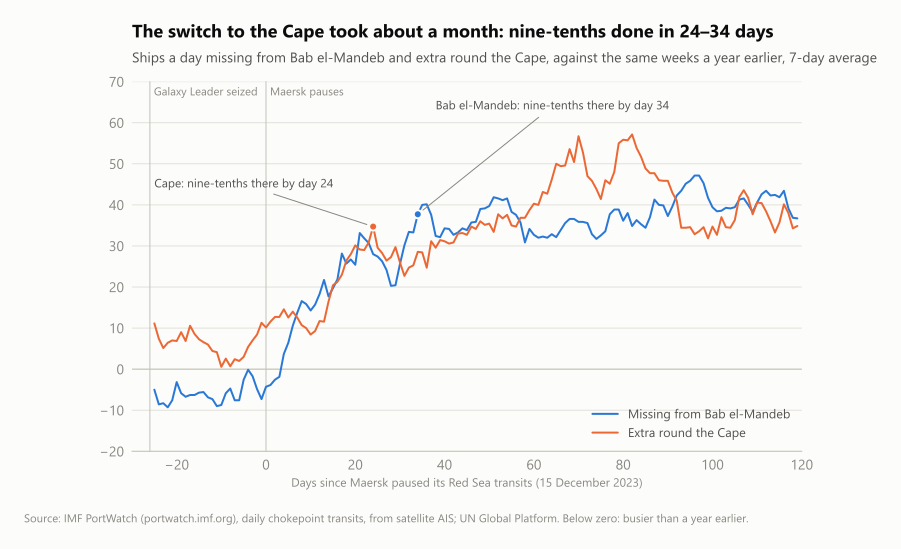
- The missing ships went round Africa. Over 2024 and 2025, the Red Sea was 41 ships a day below normal and the Cape 40 above. Both routes reached nine-tenths of their new level within 24 to 34 days of Maersk pausing its Red Sea sailings.
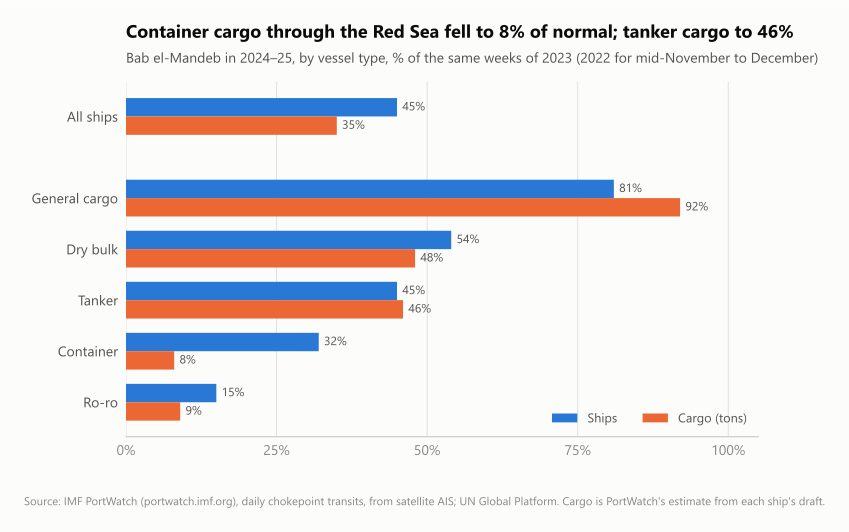
- Container lines left; tankers held on better. Container ships crossed at 32% of normal and carried 74% less cargo each, so container cargo fell to 8% of normal.
- In 2026 the Strait of Hormuz closed as well, falling from 89% of normal to 3% in the four weeks after the strikes on Iran.
What to be careful about
Counts are a floor near conflict zones, because ships can switch their trackers off and signal jamming is common there. Cargo is modelled from how low each ship sits in the water, so I use ship counts for headlines.
What I’d do next
Re-run everything against a 2019 baseline, and add freight rates to put a price on the detour.