Deep Field
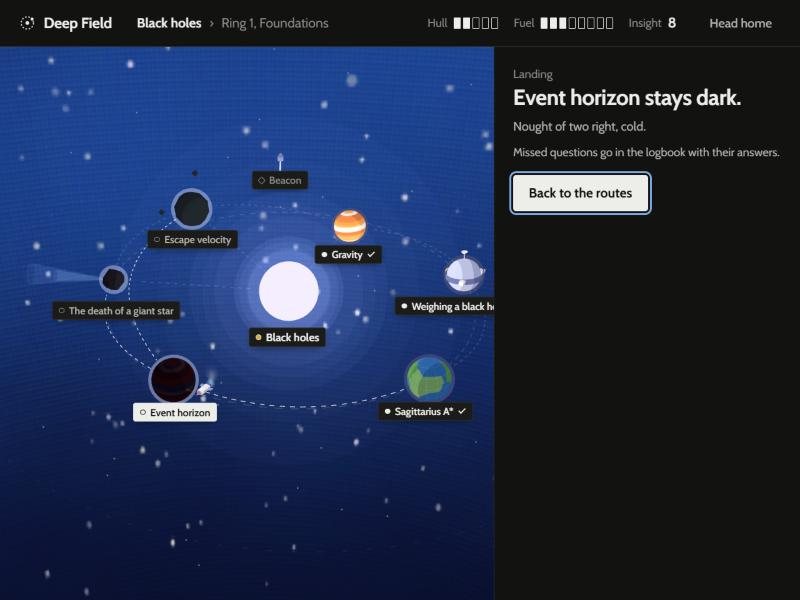
A space game for learning: a subject is a star system, its topics are planets, and you light each planet by answering its questions.
- Type
- Software
- Year
- 2026
- Built
- 18 to 27 October 2026
- My part
- The choice of a roguelite for strangers playing solo, in short or long sittings, and testing the rules
- Built with
- Claude Code (AI coding assistant)
- Tools
- three.js, JavaScript, Vite, Electron
- Content
- Two subjects written by hand, Black holes and the Roman Republic: 144 questions
The idea
Flashcard apps work, but nobody wants to open them. I wanted a learning game with the pull of a roguelite, where every run is a little different and you want one more go.
How a run works
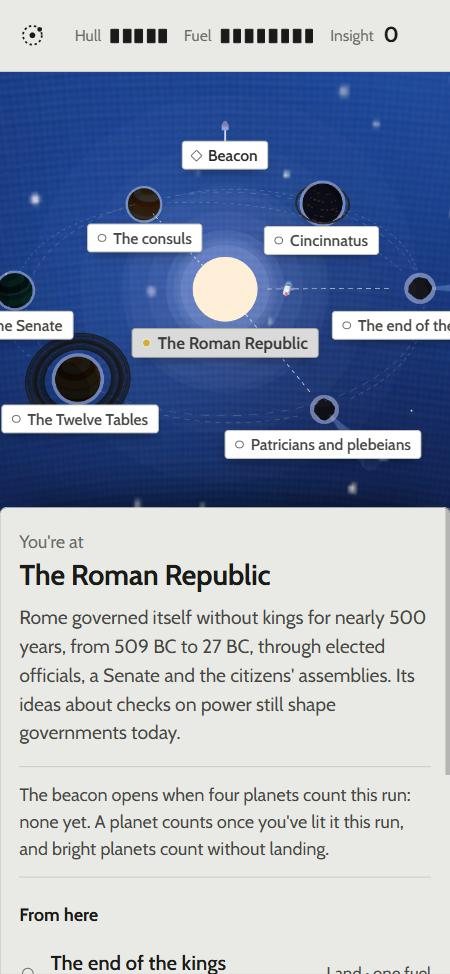
Each subject is a star system, and its topics are planets on rings. You fly to a planet and answer two questions to light it. Scanning a planet first, to read its briefing, costs fuel; wrong answers cost hull. Light four of a ring’s six planets and its beacon opens; light the beacon and you can push on into the next ring or head home. If your hull runs out you’re towed home with half of what you’d earned.
Answering without scanning first is worth double, so the game rewards actually knowing it.
The learning underneath
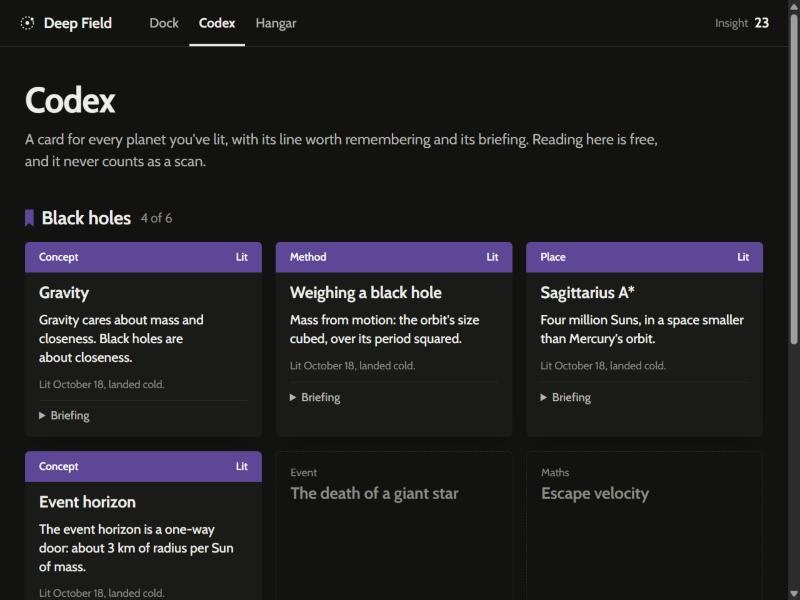
A planet counts as known only after you’ve cleared it cleanly on two different days, at least once without scanning. Then it fades on a schedule, after 3, 7, 21 and 60 days, and has to be checked again. That’s spaced repetition, the method flashcard apps use, built into the map: you can see what you’re forgetting.
Engineering choices
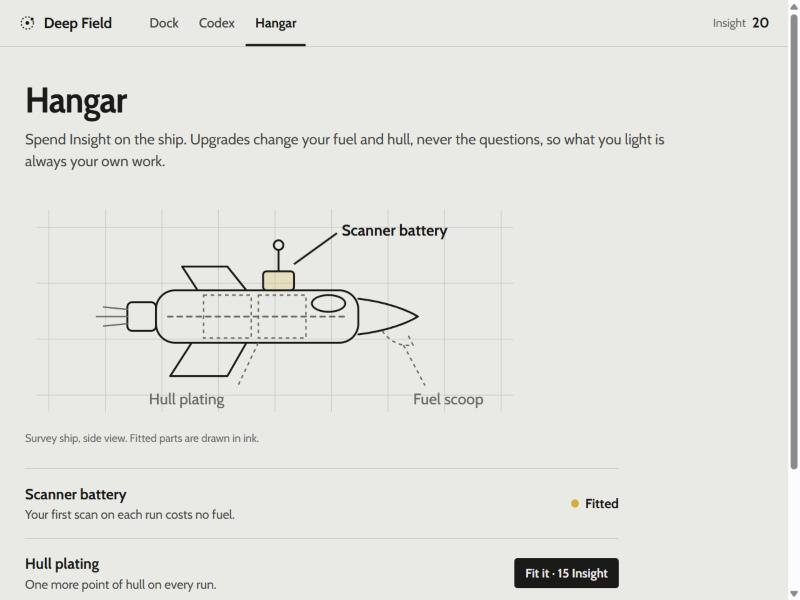
The rules of a run live in one file with no drawing code in it: fuel, hull, scoring, landings, the beacon, and how a run ends. That kept the rules easy to test and tune, and every tunable number is listed in one table. The game also runs as its own desktop app, with its own saved progress.
What I’d do next
Watch someone play it who isn’t me, and let anyone chart a new subject.