Trivium
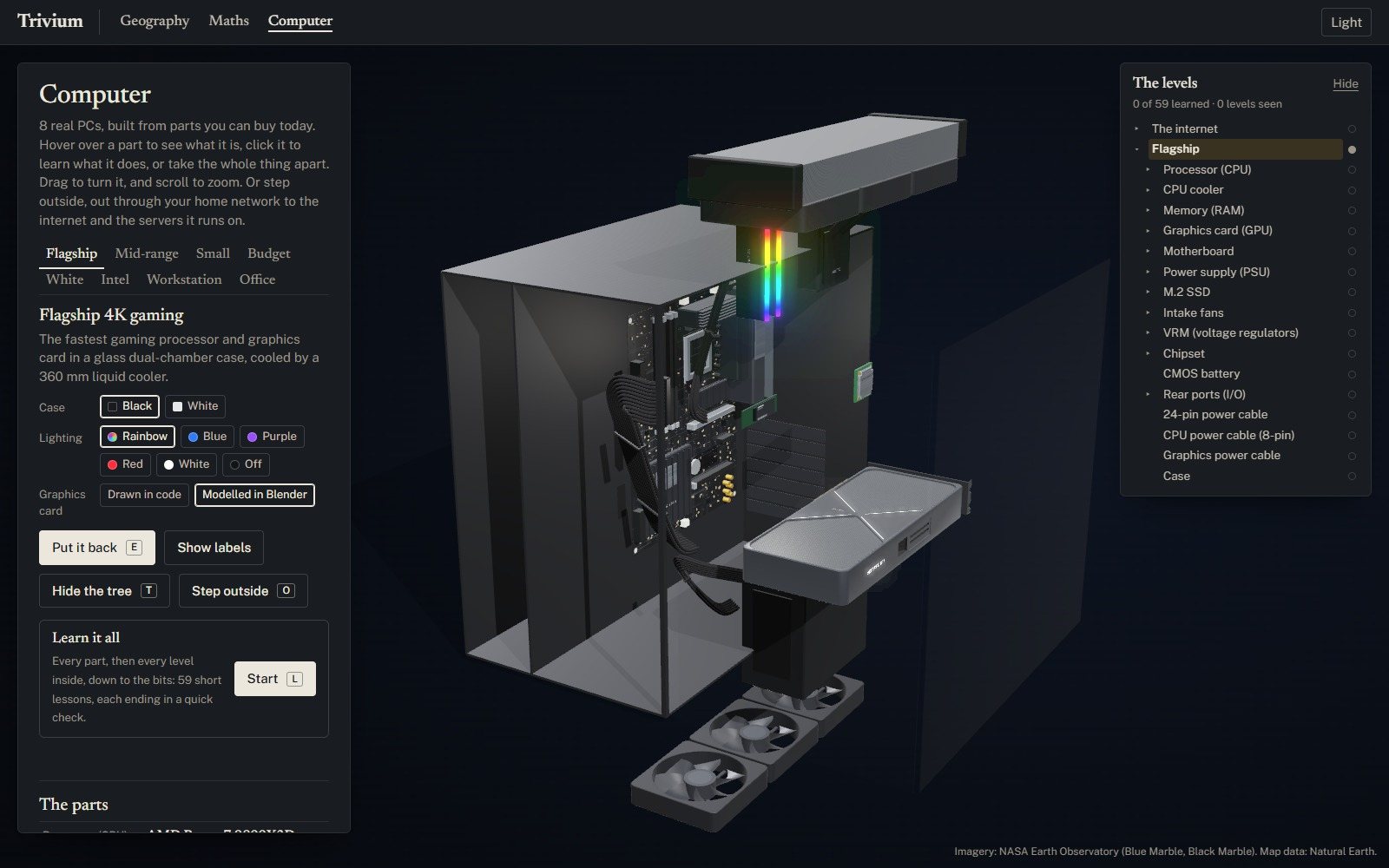
A trivia site where every subject is a 3D stage. Its computer can be taken apart, part by part, down to the transistors and the bits.
- Type
- Software
- Year
- 2026
- Built
- 18 to 25 October 2026
- My part
- The concept and the stages, the choice of a realistic look, ruling out AI-generated 3D models, the PC builds to show, and testing every level
- Built with
- Claude Code (AI coding assistant)
- Tools
- three.js, Blender 5.2 with Python, JavaScript, Vite, Electron
- Data
- NASA Earth imagery, US Census places, GeoNames, 4,496 world regions
The idea
Trivia sites are lists of questions. I wanted each subject to be a place you can explore before you’re tested on it: a globe for geography, a computer you can take apart for hardware, a sky for astronomy. Explore first, then play rounds about what you just saw.
A computer you can take apart
The computer stage has eight real PC builds you could buy today, from a budget build to a workstation, with every part checked against the maker’s spec sheet. You open the case, pick a part and go inside it, one level at a time.
Wherever a part stores or moves data, the levels end at the 1s and 0s, and the last levels are working circuits: a full adder, a NAND gate, a transistor, SRAM, DRAM, flash and magnetic bits. A graphics card, for example, leads down through its tensor and ray-tracing cores, its memory controller and the GDDR7 signal, a PCIe lane, the power stage and its MOSFETs, and the display engine down to a single pixel. A tree on the side shows the path you’ve taken down, and a “learn it all” mode walks through every level with a check at the end of each lesson.
Modelling the graphics cards
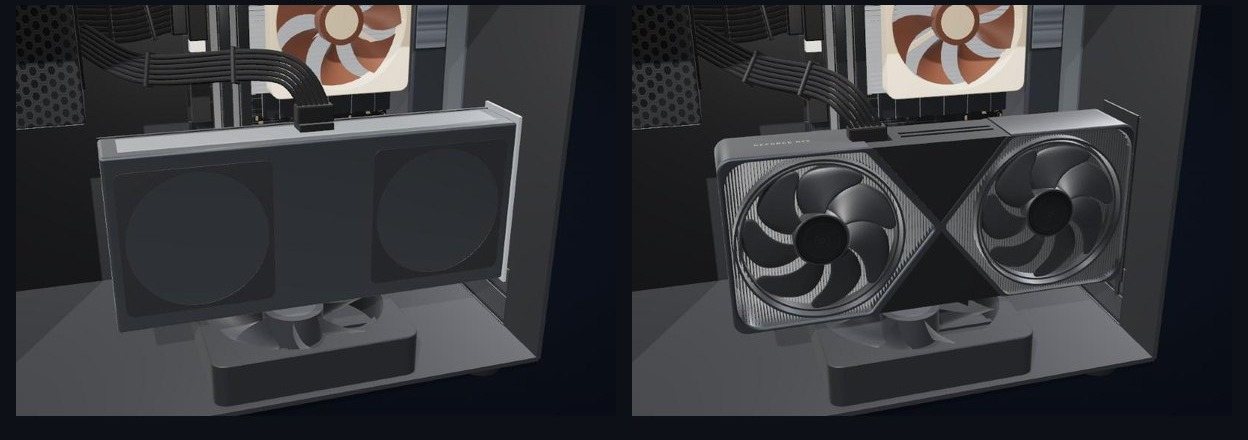
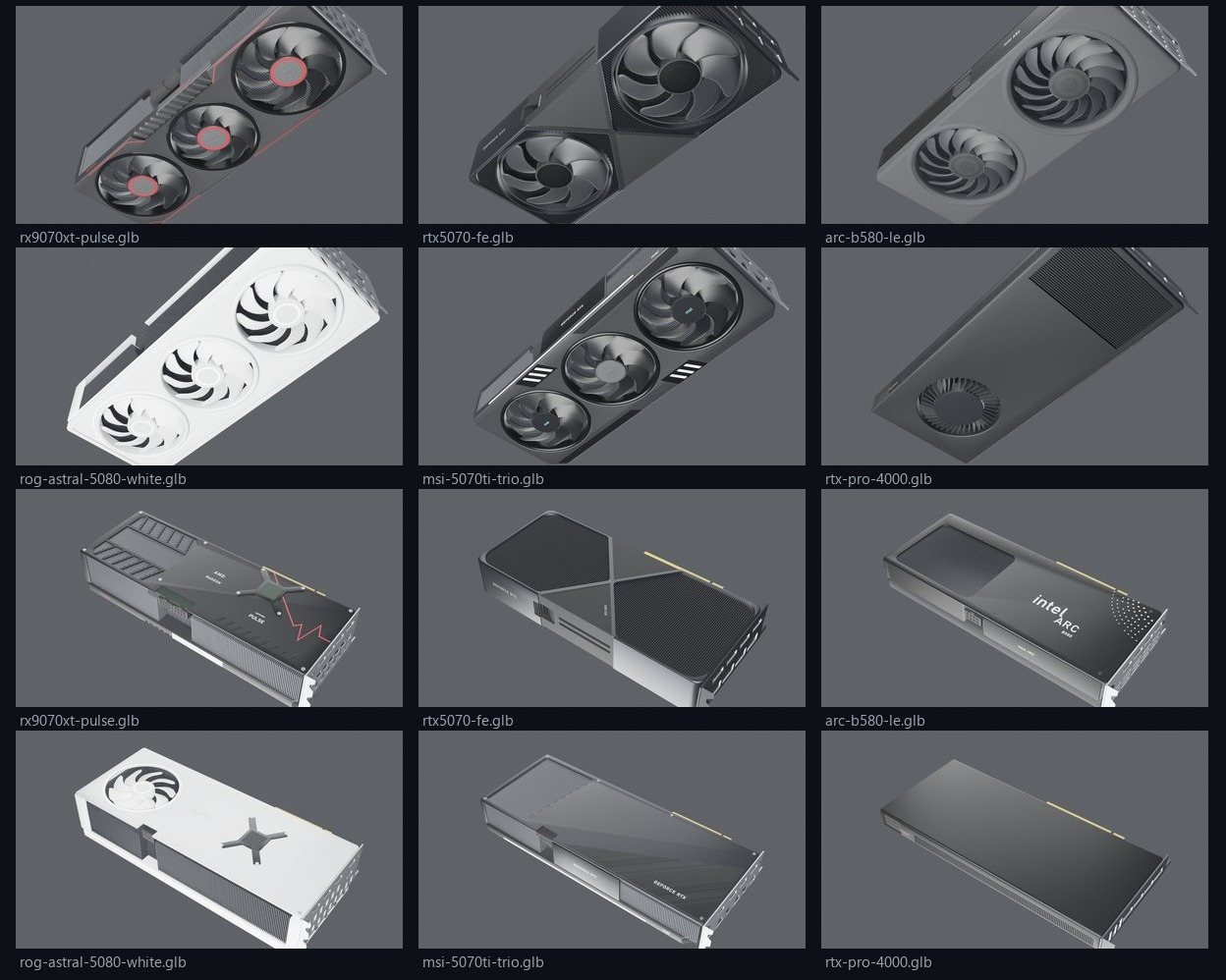
The first graphics cards were drawn in code from boxes and cylinders, and they looked like toys. I wanted them to look real, and I didn’t want AI-generated 3D models, so each card is modelled by a Python script that runs in Blender. One shared kit builds fans, shrouds, heat-sink fins and backplates, and each card has its own script that sets its size and details. The same method models 26 of the inside levels.
The globe
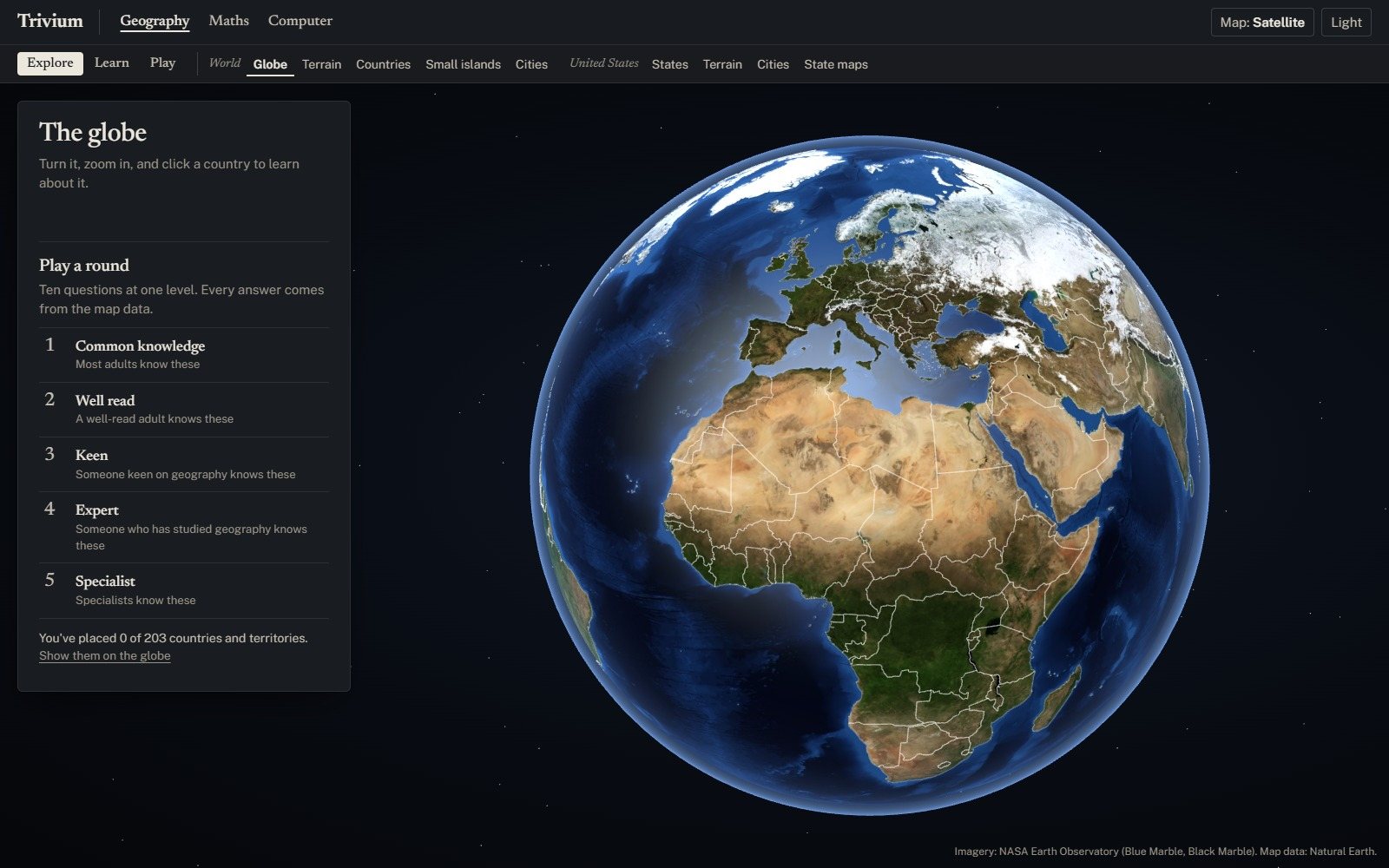
The globe stage has tabs for Earth, terrain, countries, small islands and US states, with ten-question rounds of fifteen kinds at five levels. Tiny countries get bigger click targets, and a hand-checked layer sits between the map data and the player, because the raw data gets things wrong. Every country and US state opens as a raised-relief board with its towns, roads, rivers and landmarks. Two games teach the 50 states and the 195 countries, bringing each one back for review after 1, 3, 7, 21 and 60 days.
What was hard
- Real data needs checking by hand. Somaliland, Northern Cyprus, military bases and Antarctica all broke the simple rules, and each needed a decision about how to show it.
- Size. The world maps came to about 380 MB, so the build stopped copying them and the desktop app reads them in place.
- Smooth movement. Going between levels felt jumpy until each move flew in at the part and dissolved into the next level, with the camera starting on the part you left.
What I’d do next
Build the Sky stage, and test the computer levels on people who don’t already know how a computer works.